
The B2B Guide to Custom Cotton Canvas Bags: How Brands Scale Sourcing with Paccific Ammara White-Label Manufacturing
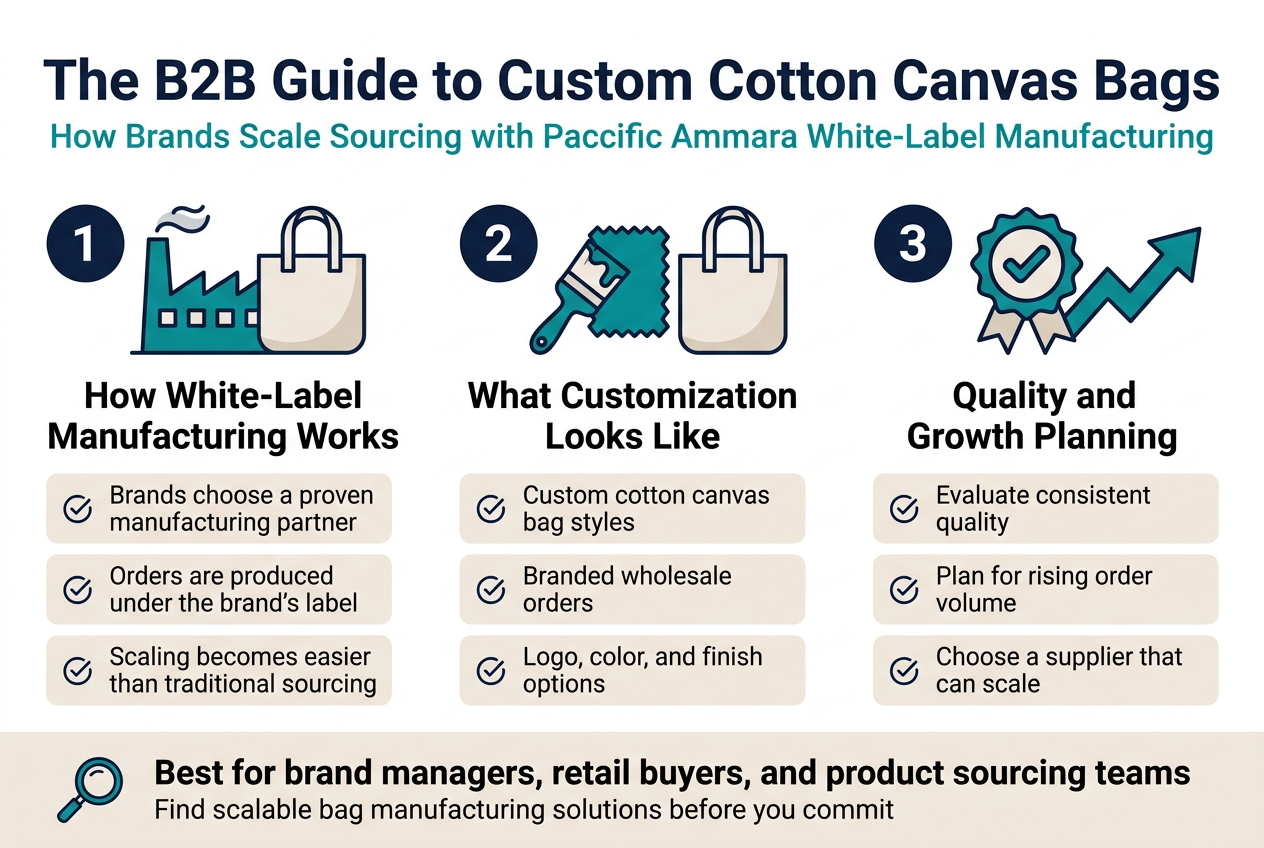
If you’re a brand manager, retail buyer, or product sourcing lead trying to figure out how to get custom cotton canvas bags made at scale without the usual headaches — this guide is for you.
Sourcing B2B custom tote bags sounds straightforward until you’re dealing with inconsistent quality, minimum order confusion, or a manufacturer that can’t keep up when your volume doubles. That’s where a reliable white-label bag manufacturer changes the game.
In this guide, we’re breaking down three things that matter most when you’re scaling:
-
- How the white-label manufacturing model actually works — and why brands are choosing it over traditional sourcing
-
- What customization really looks like when you’re ordering branded cotton bags wholesale through a manufacturer like Paccific Ammara
-
- How to evaluate quality and plan for growth so you’re not locked into a supplier that can’t scale with you
Whether you’re placing your first bulk order or renegotiating an existing supply chain, you’ll walk away with a clear picture of how scalable bag manufacturing solutions work in the real world — and what to look for before you commit.
Why B2B Brands Are Turning to Custom Cotton Canvas Bags
The Rise of Eco-Conscious Corporate Gifting and Branded Merchandise
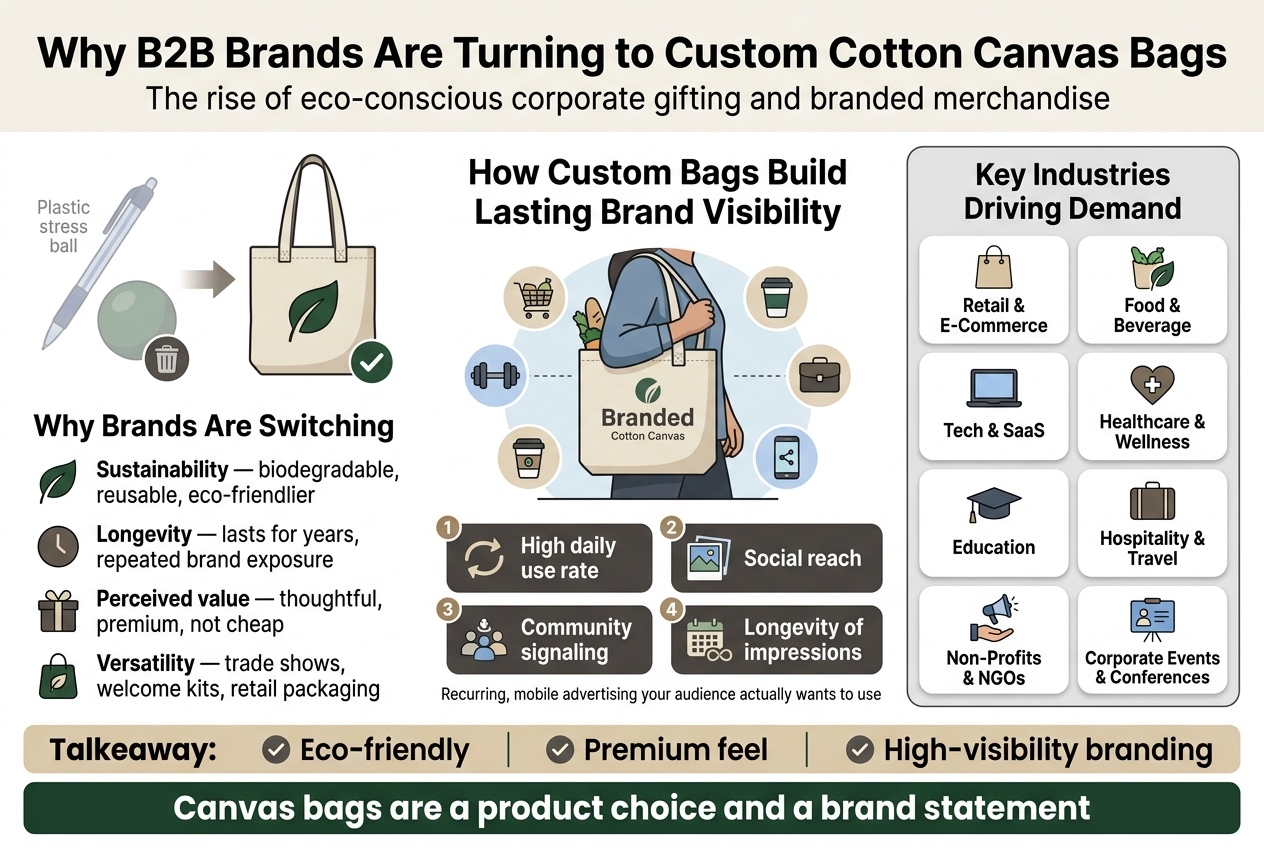
Something significant has shifted in how businesses think about branded merchandise. A few years ago, the default corporate gift was a plastic pen or a foam stress ball — items that ended up in a drawer and eventually a landfill. Today, brands are being held to a higher standard, both by their customers and by their own internal sustainability commitments.
Custom cotton canvas bags have stepped into this space in a big way. They check every box that modern B2B buyers care about:
-
- Sustainability — Cotton canvas is biodegradable and reusable, making it a genuinely eco-friendlier alternative to single-use plastic or cheap synthetic bags.
-
- Longevity — A well-made canvas tote can last for years, giving a brand repeated exposure every time it’s carried.
-
- Perceived value — Canvas feels substantial. It reads as thoughtful, not cheap. That matters when you’re gifting to clients, partners, or employees.
-
- Versatility — From trade show giveaways to employee welcome kits to retail packaging, canvas bags fit seamlessly into dozens of branded touchpoints.
Corporate gifting as an industry is growing, and eco-friendly custom canvas bags bulk orders are right at the center of that growth. Companies ranging from tech startups to global enterprises are replacing throwaway swag with items people actually want to keep — and canvas bags are leading that charge.
B2B buyers sourcing branded cotton bags wholesale aren’t just making a product decision. They’re making a statement about what their brand stands for. That alignment between product choice and brand values is exactly why demand for custom cotton canvas bags has surged across sectors.
How Custom Bags Build Lasting Brand Visibility
Think about how many times a reusable tote bag gets seen in a single week. Someone carries it to the grocery store, the gym, a coffee shop, a work meeting. Every trip is a free brand impression — one that a company didn’t have to pay for after the initial order.
This is the core reason B2B custom tote bags have become such a smart marketing investment. The cost-per-impression on a quality canvas bag is remarkably low compared to almost any other branded merchandise category.
Here’s how custom bags create ongoing brand visibility:
-
- High daily use rate — Reusable bags are practical. People use them constantly, which keeps your logo in public view far more often than a branded notebook or desk item.
-
- Social reach — Aesthetically designed bags get noticed. Customers photograph them, share them, and sometimes even seek them out. A well-designed canvas bag can generate organic social media exposure.
-
- Community signaling — Carrying a brand’s bag is a subtle endorsement. When someone chooses to use your branded tote over a plain one, they’re communicating something about their relationship with your brand.
-
- Longevity of impressions — Unlike a digital ad that disappears in seconds, a canvas bag keeps delivering impressions for months or even years.
For B2B brands investing in bulk canvas bag sourcing, the math works out clearly. You’re not just buying a product — you’re buying recurring, mobile advertising that your audience actually wants to participate in.
The key is quality. A flimsy bag that falls apart after two uses does the opposite of what you want. It signals that your brand cuts corners. A durable, well-constructed bag sends exactly the right message, which is why working with a reliable white-label bag manufacturer matters so much when you’re placing large orders.
Key Industries Driving Demand for Bulk Canvas Bag Orders
Demand for custom cotton canvas bags isn’t concentrated in one sector. It spans a wide and growing range of industries, each with its own specific reasons for scaling their sourcing.
| Industry | Primary Use Case | Why Canvas Bags Work |
|---|---|---|
| Retail & E-Commerce | Packaging, loyalty gifts, unboxing experience | Adds perceived value; encourages repeat purchases |
| Food & Beverage | Branded grocery totes, farmers market packaging | Aligns with natural/organic brand positioning |
| Tech & SaaS | Employee onboarding kits, conference swag | Practical, premium feel; high carry rate |
| Healthcare & Wellness | Patient welcome bags, health fair giveaways | Communicates care and sustainability values |
| Education | Student orientation kits, alumni merchandise | Durable, affordable at scale, widely used |
| Hospitality & Travel | Hotel guest amenity bags, travel accessories | Functional and reusable; extends brand experience |
| Non-Profits & NGOs | Fundraising merchandise, awareness campaigns | Cotton canvas aligns with mission-driven branding |
| Corporate Events & Conferences | Delegate bags, sponsor gifts | High visibility, practical for event settings |
A few industries deserve a closer look:
Retail and E-Commerce
Retail brands have discovered that the packaging experience is part of the product experience. Shipping orders in a branded cotton tote instead of a plain cardboard box immediately elevates the unboxing moment. Wholesale cotton tote bags B2B sourcing has become a packaging strategy, not just a merchandise strategy, for many DTC and e-commerce brands.
Tech and Corporate Sectors
Tech companies and professional services firms are among the heaviest buyers of custom bag manufacturer for brands services. Employee onboarding kits that include a quality branded tote feel more premium than a branded lanyard or sticker pack. At conferences and trade shows, a well-designed canvas bag gets used throughout the event — meaning your brand logo circulates through the venue all day.
Food, Beverage, and Lifestyle Brands
For brands built around natural ingredients, sustainability, or healthy living, eco-friendly custom canvas bags bulk orders are almost a brand requirement. The product communicates the brand’s values without saying a word. A cotton canvas bag from an organic tea company or a farm-to-table restaurant feels authentic in a way that a plastic bag never could.
Non-Profits and Mission-Driven Organizations
Non-profits and advocacy groups rely heavily on branded merchandise for fundraising and awareness. Private label canvas bags that carry a cause’s message can be sold, gifted, or distributed at events. They’re affordable enough to order at scale and meaningful enough that recipients genuinely want to use them.
The common thread across all these industries is the same: organizations need a product that represents their brand well, holds up over time, and can be ordered reliably in large volumes. That’s exactly the gap that scalable bag manufacturing solutions are designed to fill.
Understanding the White-Label Manufacturing Model
What White-Label Manufacturing Means for Branded Bags
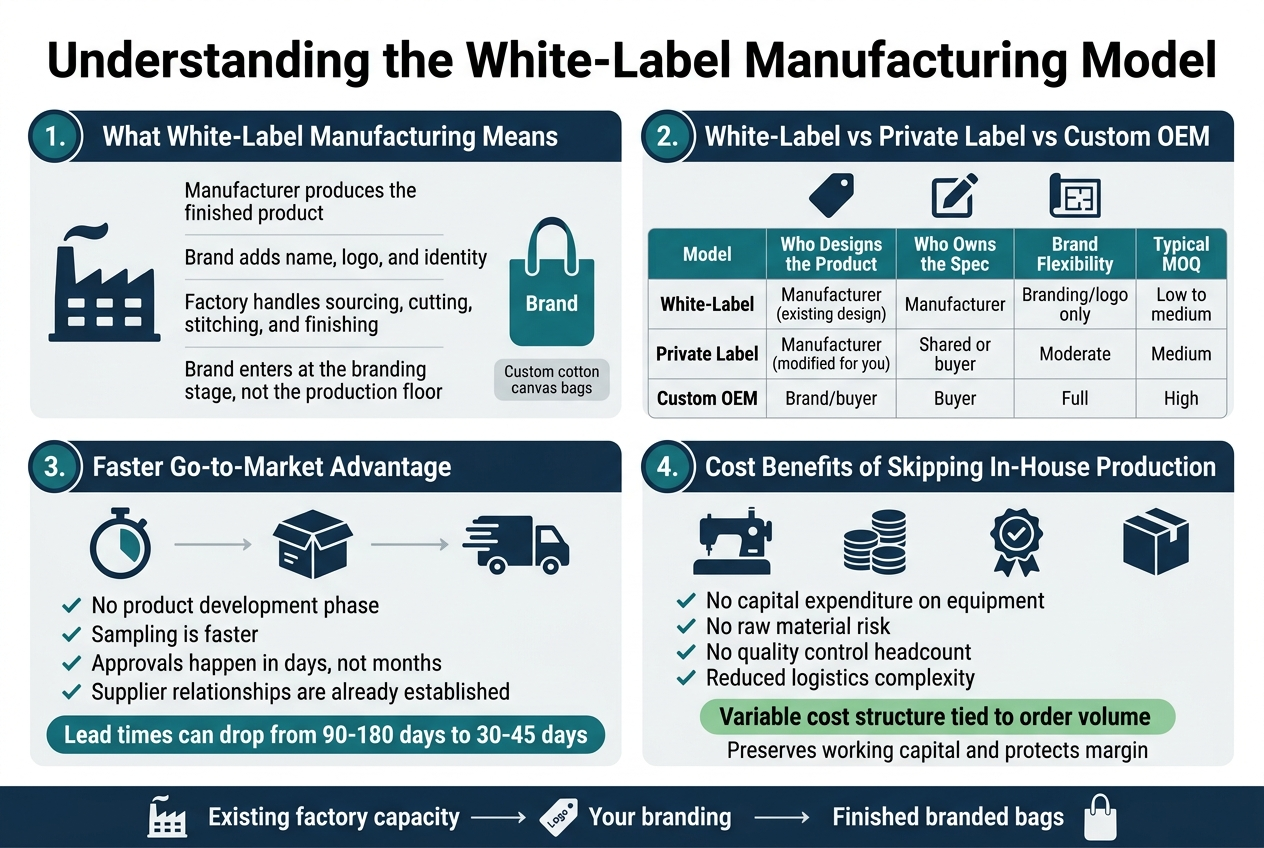
White-label manufacturing is straightforward: a manufacturer produces a finished product — in this case, custom cotton canvas bags — and a brand puts its name, logo, and identity on it. The factory handles everything from material sourcing and cutting to stitching and finishing. You show up at the branding stage, not the production floor.
For bag sourcing specifically, this means you’re working with a production facility that already has the machinery, skilled labor, supply chain relationships, and quality systems in place. You’re not building any of that from scratch. You’re tapping into an existing, proven operation and directing it toward your brand’s needs.
This model is especially powerful for B2B brands because:
-
- Product consistency is built into the manufacturing process, not dependent on your internal team’s oversight
-
- Production capacity scales independently of your headcount
-
- Brand presentation stays sharp because the manufacturer already knows how to execute finishes, handles, and fabric weights at a professional level
When you source branded cotton bags wholesale through a white-label partner, you’re essentially getting factory-grade product quality with brand-agency-level presentation — without having to manage either in-house.
How It Differs from Private Label and Custom OEM Production
These three terms get thrown around interchangeably, but they describe meaningfully different working relationships. Getting clear on the differences saves you from signing the wrong kind of sourcing agreement.
| Model | Who Designs the Product | Who Owns the Spec | Brand Flexibility | Typical MOQ |
|---|---|---|---|---|
| White-Label | Manufacturer (existing design) | Manufacturer | Branding/logo only | Low to medium |
| Private Label | Manufacturer (modified for you) | Shared or buyer | Moderate | Medium |
| Custom OEM | Brand/buyer | Buyer | Full | High |
Here’s the practical breakdown:
White-label means you’re selecting from a manufacturer’s existing bag lineup — proven silhouettes, tested fabric weights, established construction. You add your branding. This is the fastest and most capital-efficient route to market.
Private label canvas bags involve a step further — you may request changes to the base design. Maybe a different strap length, an added interior pocket, or a specific fabric blend. The manufacturer still leads the design and production process, but your fingerprints are on the spec sheet.
Custom OEM (Original Equipment Manufacturer) production is when you bring your own design to a factory and ask them to manufacture it to your exact specifications. You own the design fully. This gives you the most differentiation but also comes with higher MOQs, longer development timelines, and greater upfront investment in sampling and prototyping.
For most B2B brands scaling their bulk canvas bag sourcing, white-label hits the sweet spot — speed, cost control, and solid brand expression without the complexity of full OEM development.
Why It Gives Brands Faster Go-to-Market Advantage
Speed matters enormously in B2B sourcing. Whether you’re supplying retail clients, running a corporate gifting program, or building a wholesale catalog, waiting six months for a product development cycle to close is a real business problem.
White-label manufacturing compresses that timeline significantly. Here’s why:
-
- No product development phase. The base product already exists. Construction is tested. Materials are proven. You’re not starting from zero.
-
- Sampling is faster. Because the manufacturer is working from an existing template rather than interpreting a new design, samples come back quicker and closer to final spec.
-
- Approvals happen in days, not months. Fewer revision cycles mean fewer delays between your purchase order and your delivery date.
-
- Supplier relationships are already established. A good white-label bag manufacturer already has fabric suppliers, hardware vendors, and trim sourcing locked in. You’re not waiting on their supply chain to catch up.
For B2B custom tote bags that need to hit seasonal campaigns, trade show deadlines, or new client onboarding timelines, this speed advantage is not just convenient — it’s genuinely competitive. Brands that can promise clients fast turnaround on branded merchandise win more contracts.
The reality is that most competitors using custom OEM production are working with 90–180 day lead times on new SKUs. A white-label approach can bring that down to 30–45 days in many cases, sometimes even less for reorders.
Cost Benefits of Skipping In-House Production
Running your own production — even a small-scale operation — carries overhead that compounds fast. Equipment, facility space, quality control staff, raw material purchasing, inventory management — each of these is a cost center that requires ongoing attention and capital.
White-label manufacturing eliminates all of that from your balance sheet. Instead of absorbing fixed costs, you’re working with a variable cost structure tied directly to your order volume.
Here’s where the savings actually show up:
-
- No capital expenditure on equipment. Industrial sewing machines, cutting tables, printing rigs — none of that is your problem. The white-label manufacturer has already made those investments.
-
- No raw material risk. You’re not buying fabric rolls and hoping demand materializes. You order what you need when you need it.
-
- No quality control headcount. A credible manufacturer has internal QC systems. You benefit from their process without putting QC staff on your payroll.
-
- Economies of scale from day one. When you source wholesale cotton tote bags B2B through a white-label partner, you’re buying into the manufacturer’s existing volume discounts on materials — even if your individual order size is modest.
-
- Reduced logistics complexity. Most white-label manufacturers are set up to ship directly to your warehouse or even fulfill to end clients, cutting out additional logistics layers.
For growing brands, this cost structure is a strategic asset. It keeps overhead low during early scaling phases, preserves working capital for marketing and client acquisition, and lets you grow revenue before you need to grow your cost base.
The financial case for scalable bag manufacturing solutions through white-label partnerships is especially strong for brands in the eco-friendly custom canvas bags bulk space, where margins are already being squeezed by rising material costs. Keeping production overhead off your books is one of the most effective ways to protect margin while still delivering a quality branded product.
How Paccific Ammara Supports B2B Scaling with White-Label Solutions
Overview of Paccific Ammara’s Manufacturing Capabilities
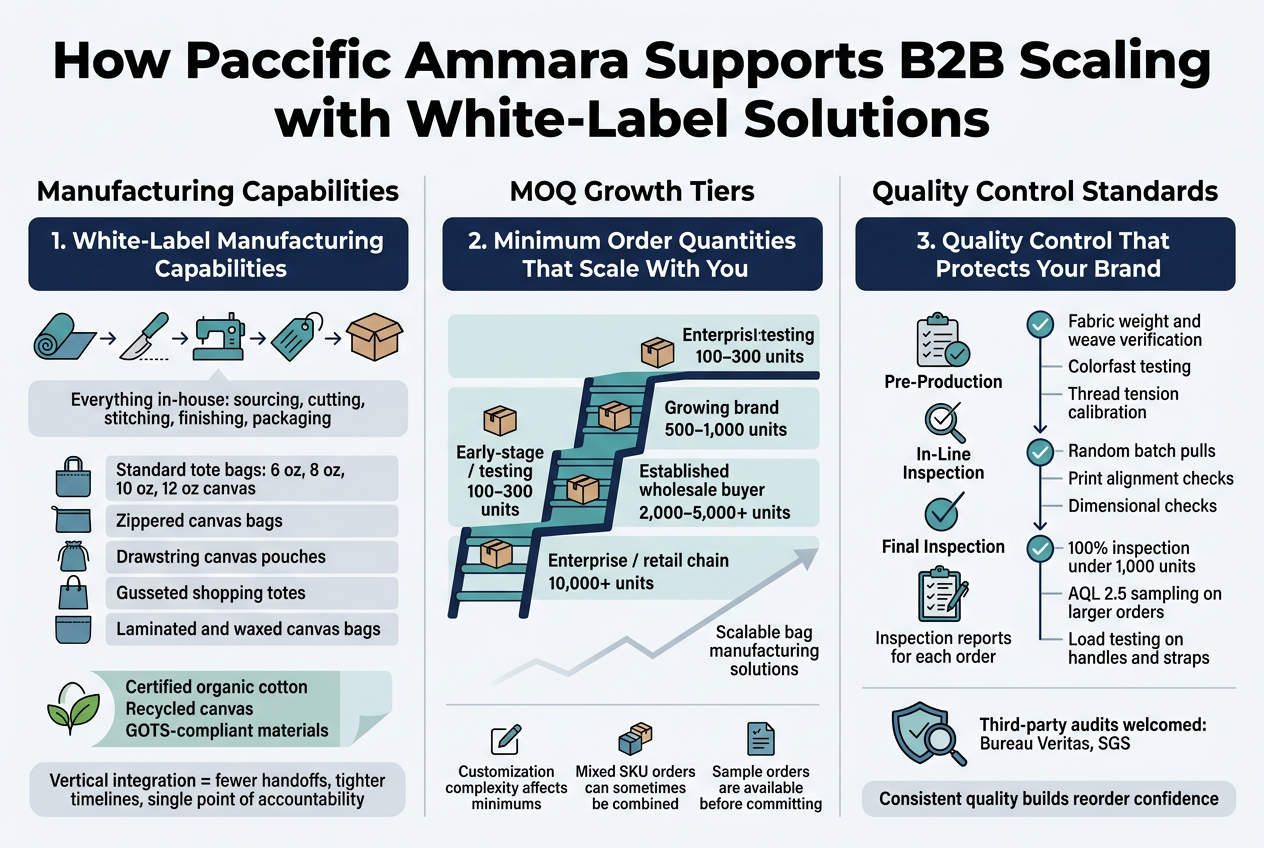
Paccific Ammara operates as a full-service white-label bag manufacturer built specifically to handle the demands of growing B2B brands. The facility handles everything in-house — from raw fabric sourcing and cutting to stitching, finishing, and packaging — which means fewer handoffs, tighter timelines, and a single point of accountability for your entire order.
The production setup supports a wide range of custom cotton canvas bags, including:
-
- Standard tote bags in various weights (6 oz, 8 oz, 10 oz, 12 oz canvas)
-
- Zippered canvas bags for retail and corporate gifting
-
- Drawstring canvas pouches suited for product packaging
-
- Gusseted shopping totes with reinforced handles for heavy-load use
-
- Laminated and waxed canvas bags for premium product lines
What makes Paccific Ammara a strong fit for B2B custom tote bags specifically is the vertical integration. Brands working with white-label manufacturers often run into quality inconsistencies when multiple subcontractors handle different production stages. Paccific Ammara keeps everything under one roof, which cuts down on variation between batches — something that matters enormously when you’re placing repeat orders across multiple seasons.
The team also works with certified organic cotton, recycled canvas, and GOTS-compliant materials for brands that need to meet sustainability commitments. If eco-friendly custom canvas bags bulk sourcing is part of your brand positioning, this is where the material options genuinely support that story rather than just papering over it with vague claims.
Minimum Order Quantities Designed for Business Growth
One of the biggest friction points when sourcing private label canvas bags is finding a manufacturer whose MOQs actually match where your business is right now — not where they wish you already were.
Paccific Ammara structures its minimum order quantities to accommodate brands at different stages:
| Business Stage | Suggested MOQ | Notes |
|---|---|---|
| Early-stage / testing | 100–300 units | Ideal for market testing and retail pilot programs |
| Growing brand | 500–1,000 units | Access to deeper per-unit pricing |
| Established wholesale buyer | 2,000–5,000+ units | Full pricing tiers, priority production slots |
| Enterprise / retail chain | 10,000+ units | Custom production scheduling, dedicated account manager |
This tiered approach makes scalable bag manufacturing solutions accessible without forcing small or mid-size brands into over-committing on inventory before they’ve validated demand. A boutique retailer testing a new branded bag line doesn’t need the same starting point as a national grocery chain rolling out a new private label tote program.
A few things to keep in mind when evaluating MOQs:
-
- Customization complexity affects minimums. Simple single-color screen prints typically carry lower MOQs than multi-color embroidery or all-over prints.
-
- Mixed SKU orders can sometimes be combined. If you’re sourcing multiple bag styles under one brand, Paccific Ammara can often blend SKUs to meet a combined minimum rather than requiring separate MOQ thresholds per style.
-
- Sample orders are available before committing. This is worth asking about early in the conversation — getting physical samples before locking into production quantities saves significant headache down the line.
For brands scaling bulk canvas bag sourcing across retail, events, and corporate channels, having a manufacturer that grows with you — rather than one where you constantly outgrow their capacity or struggle to meet their floor — is the kind of operational detail that compounds over time.
Quality Control Standards That Protect Your Brand Reputation
When your logo goes on a bag, that bag becomes a direct extension of your brand. A weak seam, uneven print registration, or handles that detach after three uses don’t just disappoint the end customer — they create a support problem, a refund problem, and a perception problem all at once.
Paccific Ammara runs a multi-stage quality control process that covers the full production cycle:
Pre-Production
-
- Fabric weight and weave verification against approved specifications
-
- Colorfast testing for dyed canvas to check for bleeding or fading
-
- Thread tension and stitch consistency calibration before full runs begin
In-Line Inspection
-
- Random batch pulls during production to catch drift in stitch density or handle attachment
-
- Print alignment checks for screen-printed and heat-transferred branding
-
- Dimensional checks to ensure bag dimensions stay within agreed tolerances
Final Inspection
-
- 100% inspection on orders under 1,000 units
-
- AQL (Acceptable Quality Level) sampling on larger orders, typically at AQL 2.5
-
- Load testing on handles and straps before shipment sign-off
For brands sourcing branded cotton bags wholesale, this level of documented QC is the difference between confident reordering and anxiety every time a new shipment lands. It also creates a paper trail that’s useful if you’re selling into retail environments where buyers expect quality documentation.
Paccific Ammara’s QC team produces inspection reports for each order, and for brands requiring third-party verification, the facility accommodates independent audits from agencies like Bureau Veritas or SGS without workflow disruption.
The consistency you get from a custom bag manufacturer for brands that takes QC seriously isn’t just about avoiding bad product — it’s about building the kind of supply chain confidence that lets you scale without second-guessing every order.
Customization Options That Drive Brand Impact
Fabric Weight, Weave, and Canvas Grade Selections
The fabric you pick isn’t just a background detail — it’s one of the most visible signals of your brand’s quality standard. When sourcing custom cotton canvas bags at scale, getting the fabric spec right from the start saves you from costly re-orders and customer complaints down the line.
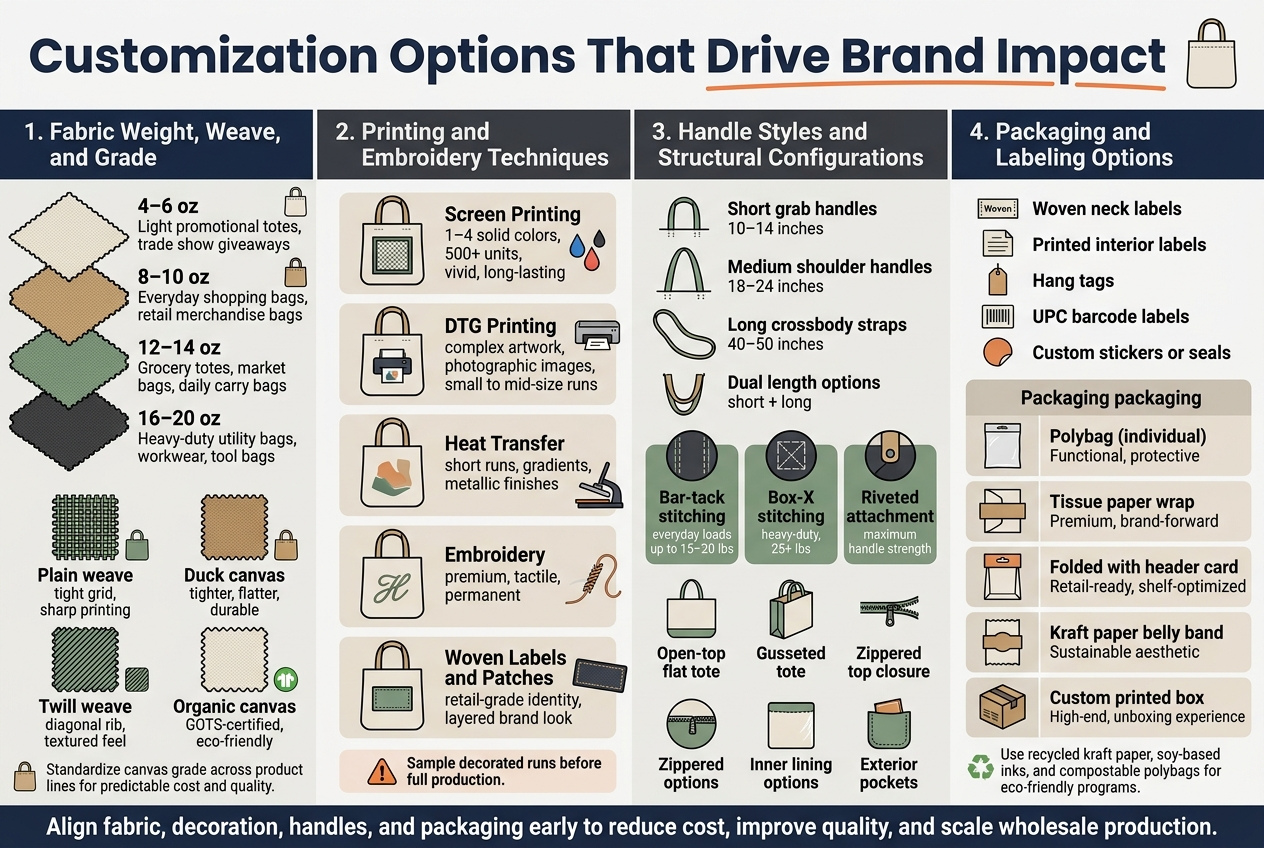
Canvas weight is measured in ounces per square yard (oz/yd²), and the right choice depends entirely on your bag’s intended use:
| Canvas Weight | Best For | Key Characteristics |
|---|---|---|
| 4–6 oz | Light promotional totes, trade show giveaways | Soft hand feel, lightweight, folds flat easily |
| 8–10 oz | Everyday shopping bags, retail merchandise bags | Good balance of durability and drape |
| 12–14 oz | Grocery totes, market bags, daily carry bags | Sturdy structure, holds shape under load |
| 16–20 oz | Heavy-duty utility bags, workwear, tool bags | Maximum strength, military-grade durability |
Beyond weight, the weave structure plays a big role in how a finished bag looks and performs:
-
- Plain weave canvas — tight, even grid pattern; excellent for printing sharp graphics
-
- Duck canvas — a tighter, flatter variation of plain weave; very durable and smooth
-
- Twill weave — diagonal rib pattern; adds visual texture and softens the feel
-
- Organic canvas — GOTS-certified cotton weaves that serve brands leaning into eco-friendly custom canvas bags bulk programs
For B2B custom tote bags ordered in high volumes, standardizing your canvas grade across product lines gives your procurement team predictable cost structures and quality benchmarks that scale without surprises.
Printing and Embroidery Techniques for Maximum Brand Visibility
Your logo is doing real marketing work every time someone carries your bag down a street, into a grocery store, or through an airport. Choosing the right application method is what determines whether that logo looks sharp on unit 1,000 or starts cracking and fading by unit 50.
Here’s a breakdown of the most common decoration techniques used in branded cotton bags wholesale programs:
Screen Printing
The go-to method for large runs with bold, solid designs. Ink is pushed through a mesh screen directly onto the canvas surface.
-
- Best for: logos with 1–4 solid colors, high-volume runs (500+ units)
-
- Pros: cost drops significantly at scale, vivid color saturation, long-lasting results
-
- Cons: not ideal for photorealistic images or gradients; each color requires a separate screen setup fee
Digital Direct-to-Garment (DTG) Printing
A newer method where inkjet technology prints directly onto the fabric surface.
-
- Best for: complex artwork, photographic images, small to mid-size runs
-
- Pros: no minimum setup fees, handles unlimited colors easily
-
- Cons: slightly softer vibrancy on dark canvas; requires pre-treatment on heavier weaves
Heat Transfer Printing
A printed design is transferred to the bag surface using heat and pressure.
-
- Best for: short runs, detailed color gradients, metallic or specialty finishes
-
- Pros: fast turnaround, works well on curved or structured areas
-
- Cons: less breathable feel on the printed area; durability is lower than screen print on heavy use bags
Embroidery
Thread is stitched directly into the canvas in your brand’s design. This is the premium choice for private label canvas bags targeting upscale retail or corporate gifting.
-
- Best for: logos, monograms, wordmarks
-
- Pros: tactile, three-dimensional appearance; essentially permanent; communicates quality
-
- Cons: higher per-unit cost; fine details and very small text can lose clarity
Woven Labels and Patches
Custom-woven labels or embroidered patches sewn onto the bag surface. Widely used by fashion brands and lifestyle labels.
-
- Adds a retail-grade, product-oriented brand identity
-
- Works well on handles, exterior pockets, or the bottom corner of the bag
-
- Pairs well with other printing methods for a layered brand identity
When placing orders through a white-label bag manufacturer, it’s worth asking for decorated sample runs before committing to full production. Color output varies between fabric weights, weave densities, and pre-wash treatments.
Handle Styles, Sizes, and Structural Configurations
The handle is where function and branding intersect in ways most buyers don’t think about until they’re holding a bag that feels wrong. Handle length, width, attachment method, and material all directly affect how a bag is carried, how it looks on a shelf, and how long it holds up over time.
Common handle configurations in B2B canvas bag programs:
| Handle Type | Length Range | Best Application |
|---|---|---|
| Short grab handles | 10–14 inches | Handheld totes, luxury retail bags |
| Medium shoulder handles | 18–24 inches | Everyday shopping and grocery bags |
| Long crossbody straps | 40–50 inches | Commuter bags, market bags, lifestyle brands |
| Dual length options | Combo of short + long | Versatile retail bags targeting broad demographics |
Handle construction options:
-
- Rolled cotton rope handles — casual, natural aesthetic; comfortable grip; popular in artisan and food brand packaging
-
- Flat webbing handles — most common for standard totes; available in matching or contrasting cotton tape
-
- Reinforced canvas handles — stitched from the same canvas material; clean, seamless look
-
- Leather or PU handle accents — premium finish option for retail-grade custom cotton canvas bags targeting higher price points
Attachment methods matter more than most buyers realize:
-
- Bar-tack stitching — standard reinforced stitch at handle attachment points; adequate for everyday loads up to 15–20 lbs
-
- Box-X stitching — cross-pattern reinforcement; used for heavy-duty bags and utility totes carrying 25+ lbs
-
- Riveted attachment — metal rivets added alongside stitching for maximum handle strength; common in workwear and tool bag applications
Bag structural configurations to match your specific use case:
-
- Open-top flat tote — simplest construction; lightweight; popular for promotional and trade show use
-
- Gusseted tote — side and/or bottom gussets expand capacity; better for grocery, retail, and farmers market use
-
- Zippered top closure — adds security; preferred for commuter and event merchandise bags
-
- Inner lining options — cotton, polyester, or food-safe laminate linings improve structure and functionality
-
- Exterior pockets — flat patch pockets or zippered side pockets for added utility in commuter-focused designs
When you’re running a scalable bag manufacturing solution across multiple product SKUs, standardizing handle specs across your core range makes re-ordering cleaner and minimizes per-unit variation between production runs.
Packaging and Labeling Options for Retail-Ready Delivery
When bags arrive retail-ready, your team spends less time processing and more time selling. For brands running bulk canvas bag sourcing programs, getting packaging and labeling right at the factory level is one of the biggest operational wins available.
Labeling options available through white-label manufacturing programs:
-
- Woven neck labels — sewn into interior seams; best for brand name, care instructions, fiber content, and country of origin
-
- Printed interior labels — heat-applied or screen-printed inside the bag; lower cost than woven; works for basic brand identification
-
- Hang tags — attached via cord or safety pin through the handle; ideal for retail display, product storytelling, and pricing
-
- UPC barcode labels — applied for retail distribution, drop-shipping, or marketplace fulfillment programs
-
- Custom stickers or seals — added to folded bags for a clean, packaged presentation at point of purchase
Packaging formats to consider:
| Packaging Type | Best For | Presentation Level |
|---|---|---|
| Polybag (individual) | E-commerce, retail floor stock | Functional, protective |
| Tissue paper wrap | Boutique retail, gift packaging | Premium, brand-forward |
| Folded with header card | Display hooks, point-of-sale fixtures | Retail-ready, shelf-optimized |
| Kraft paper belly band | Eco-brand positioning | Sustainable aesthetic |
| Custom printed box | Corporate gifting, subscription boxes | High-end, unboxing experience |
For brands sourcing wholesale cotton tote bags B2B, coordinating packaging specs with your manufacturer early in the product development phase avoids last-minute costs and delays. A factory that handles labeling and packaging as part of the production process removes an entire logistics step from your supply chain.
Brands building eco-friendly custom canvas bags bulk programs should also align their packaging materials with their sustainability positioning — recycled kraft paper, soy-based inks on hang tags, and compostable polybags all reinforce the brand story before a customer even opens the product.
Scaling Sourcing Efficiently as Your Brand Grows
How to Forecast Demand and Plan Bulk Orders Strategically
Getting your bulk canvas bag orders right comes down to one thing: knowing your numbers before your manufacturer asks for them. Brands that struggle with over-ordering or last-minute rush requests almost always skip the forecasting step — and that gets expensive fast.
Start by pulling together your historical sales data. Look at how many branded cotton bags you moved in the last 12 months, broken down by quarter. Identify your peak periods — trade show season, holiday gifting, product launches — and build a baseline from there. If you’re newer to bulk canvas bag sourcing and don’t have much history yet, lean on your marketing calendar. Map out every campaign, event, and product push planned for the next six to twelve months, then estimate bag demand for each.
Here’s a practical framework you can use:
| Planning Factor | What to Look At |
|---|---|
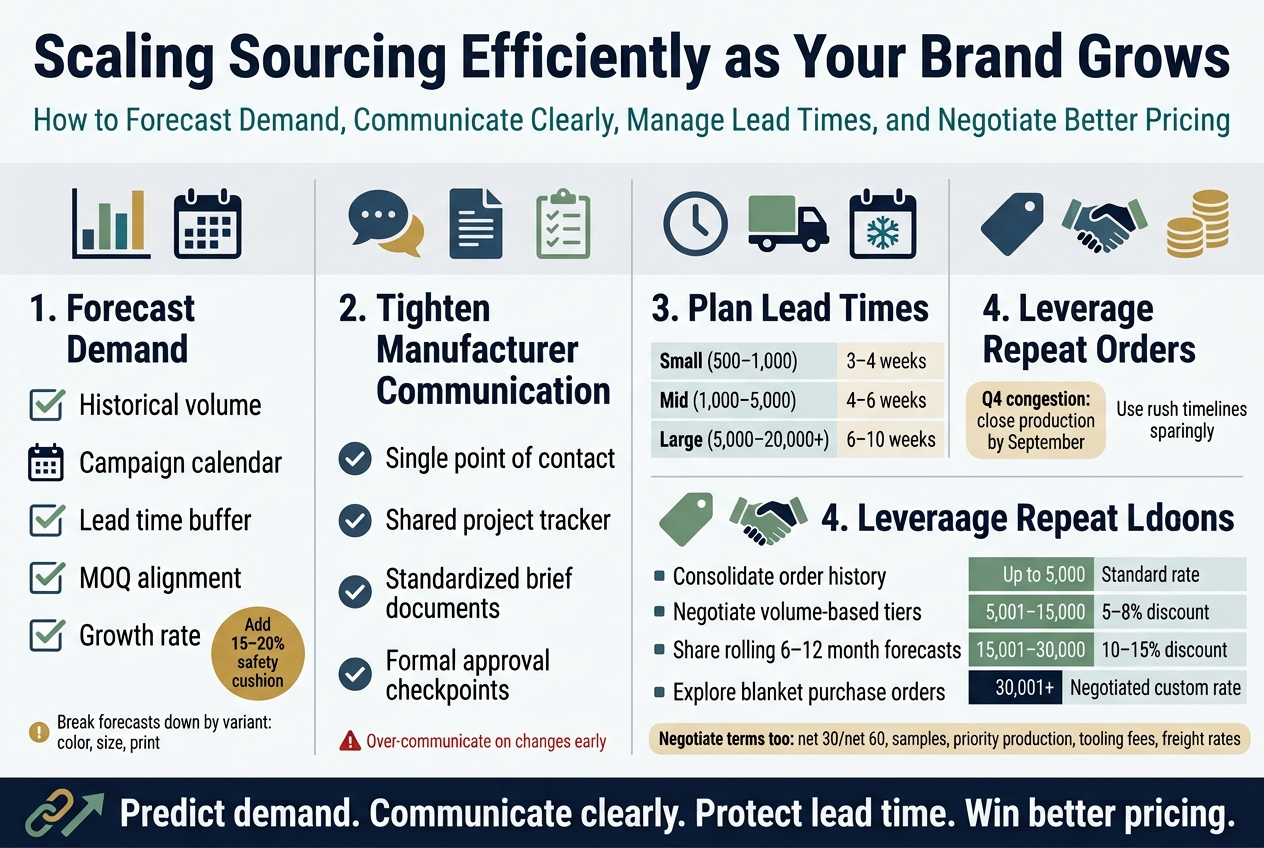
| Historical volume | Units moved per quarter over the last 1–2 years |
| Campaign calendar | Upcoming events, launches, seasonal pushes |
| Lead time buffer | Add 20–30% to account for delays or unexpected demand spikes |
| MOQ alignment | Match order size to your manufacturer’s minimum order quantities |
| Growth rate | Factor in 10–25% growth if you’re scaling actively |
Once you have a rough number, build in a buffer. Supply chains aren’t perfect, and running out of custom cotton canvas bags in the middle of a campaign costs far more than holding a little extra inventory. A general rule: order for your expected need, then add 15–20% as a safety cushion.
For B2B brands managing multiple SKUs — different colors, sizes, or print configurations — break your forecast down per variant. Don’t just order a single large batch and hope the mix works out. Work with your white-label bag manufacturer to understand which variants have longer lead times or higher MOQs, and plan those first.
Streamlining Supply Chain Communication with Your Manufacturer
One of the biggest friction points in bulk canvas bag sourcing isn’t production — it’s communication. Brands lose weeks (and sometimes entire seasons) because of back-and-forth emails, unclear spec sheets, or approval delays that pile up.
Here’s how to tighten that up:
Set up a single point of contact on both sides. Designate one person on your team who owns the manufacturer relationship. That person handles all approvals, questions, and change requests. On your manufacturer’s side, ask for a dedicated account manager or production coordinator. When multiple people are looping in from both ends without clear ownership, things fall through the cracks.
Use a shared project tracker. A simple shared document or project management tool (even a shared Google Sheet) that tracks order status, sample approvals, production milestones, and shipping timelines keeps everyone aligned without endless email chains.
Standardize your brief documents. Every time you place an order for custom B2B tote bags, send a complete brief that covers:
-
- Bag dimensions and material specs (canvas weight, strap length, construction type)
-
- Print method and artwork files (with color codes, bleed areas, and resolution specs)
-
- Quantity per variant
-
- Required in-hands date
-
- Packaging and labeling instructions
-
- Shipping address and preferred freight method
When your manufacturer receives a complete, consistent brief every time, they can move faster and you’ll get fewer revision requests.
Build in formal approval checkpoints. Don’t wait until production is done to catch an issue. Set clear stages where you review and sign off — pre-production samples, print proofs, and pre-shipment inspection reports. This is especially important for private label canvas bags where brand accuracy is non-negotiable.
Over-communicate on changes. If anything shifts on your end — timeline, quantity, design — tell your manufacturer immediately, not when it’s convenient. Changes caught early cost far less than changes caught at the final production stage.
Managing Lead Times Across Seasonal and Campaign-Driven Peaks
Lead times are one of the most underestimated variables in scalable bag manufacturing. Brands often work backward from a campaign date and assume the manufacturer can flex to fit whatever window is left. That assumption causes more sourcing headaches than almost anything else.
Know your standard lead times cold. Ask your white-label bag manufacturer for their typical production timelines broken down by order size. A general benchmark for custom cotton canvas bags looks something like this:
| Order Size | Typical Production Lead Time |
|---|---|
| Small (500–1,000 units) | 3–4 weeks |
| Mid (1,000–5,000 units) | 4–6 weeks |
| Large (5,000–20,000+ units) | 6–10 weeks |
Note: These are production timelines only. Add shipping transit time based on your region and preferred freight method.
Plan for seasonal congestion. Manufacturers that produce wholesale cotton tote bags for multiple clients feel the same seasonal crunch you do. Q4 (October through December) is universally hectic for branded merchandise. If you need bags delivered before the holiday season, your production window needs to close in September at the latest — not November.
Similarly, if you’re ordering for a spring trade show circuit, January and February are not the time to be placing your order. Lock in production in November or December.
Build a rolling order calendar. Rather than treating each order as a standalone event, map out the whole year and identify every point where you’ll need inventory. Share that calendar with your manufacturer so they can block time in advance. This is especially valuable if you’re running eco-friendly custom canvas bags bulk orders tied to specific sustainability campaigns or brand initiatives — those often need longer planning cycles because of material sourcing.
Use rush timelines sparingly. Most manufacturers can accommodate expedited production, but it comes at a cost — both financially and in terms of relationship goodwill. Save rush requests for genuine emergencies, not poor planning. If you’re consistently rushing, it’s a signal to move your planning horizon back by four to six weeks across the board.
Leveraging Repeat Orders to Negotiate Better Pricing
Repeat business is your biggest asset when it comes to getting better pricing on branded cotton bags wholesale. Manufacturers want reliable, predictable clients — and when you position yourself as one, you unlock negotiating leverage that one-time buyers simply don’t have.
Consolidate your order history into a business case. Before any pricing conversation, pull together a summary of what you’ve ordered: total units, total spend, order frequency, and any orders in the pipeline. This gives your manufacturer a clear picture of your value as a client and gives you something concrete to negotiate from.
Negotiate volume-based pricing tiers upfront. Instead of renegotiating price on every order, ask your manufacturer to set up a tiered pricing structure based on annual or cumulative volume. It might look something like this:
| Annual Volume (Units) | Price Tier |
|---|---|
| Up to 5,000 | Standard rate |
| 5,001–15,000 | 5–8% discount |
| 15,001–30,000 | 10–15% discount |
| 30,001+ | Negotiated custom rate |
These numbers vary by manufacturer and product complexity, but the principle holds: commit to volume over time, and the per-unit cost drops.
Offer predictability in exchange for better rates. If you can share a rolling six or twelve-month forecast with your manufacturer, you’re giving them something valuable — the ability to plan their production capacity, raw material purchasing, and staffing. Many manufacturers will offer better pricing or prioritized production slots in exchange for that predictability, even if the forecast isn’t a hard commitment.
Explore blanket purchase orders. A blanket PO lets you commit to a total quantity for the year upfront, then release shipments in smaller batches as needed. You get the per-unit pricing of a large order without holding all the inventory at once. This works particularly well for custom bag manufacturers for brands that have steady, ongoing demand across multiple campaigns or channels.
Don’t just negotiate on price. Sometimes the bigger win is in the terms, not the unit cost. Ask about:
-
- Extended payment terms (net 30 vs. net 60)
-
- Free or reduced-cost pre-production samples on repeat orders
-
- Priority production scheduling during peak seasons
-
- Reduced or waived tooling fees on existing designs
-
- Freight consolidation or better shipping rates on larger shipments
Building a long-term sourcing relationship with a manufacturer like Paccific Ammara means these conversations become easier and more productive over time. The more they understand your brand’s growth trajectory and ordering patterns, the better positioned they are to support you — and the more flexibility you’ll have when you need to scale quickly.
Evaluating Quality Before Committing to Large Orders
Requesting and Assessing Sample Batches Effectively
Before you place a large bulk order for custom cotton canvas bags, getting your hands on samples is non-negotiable. This step alone can save you from expensive mistakes down the line — and it’s something experienced B2B buyers take very seriously.
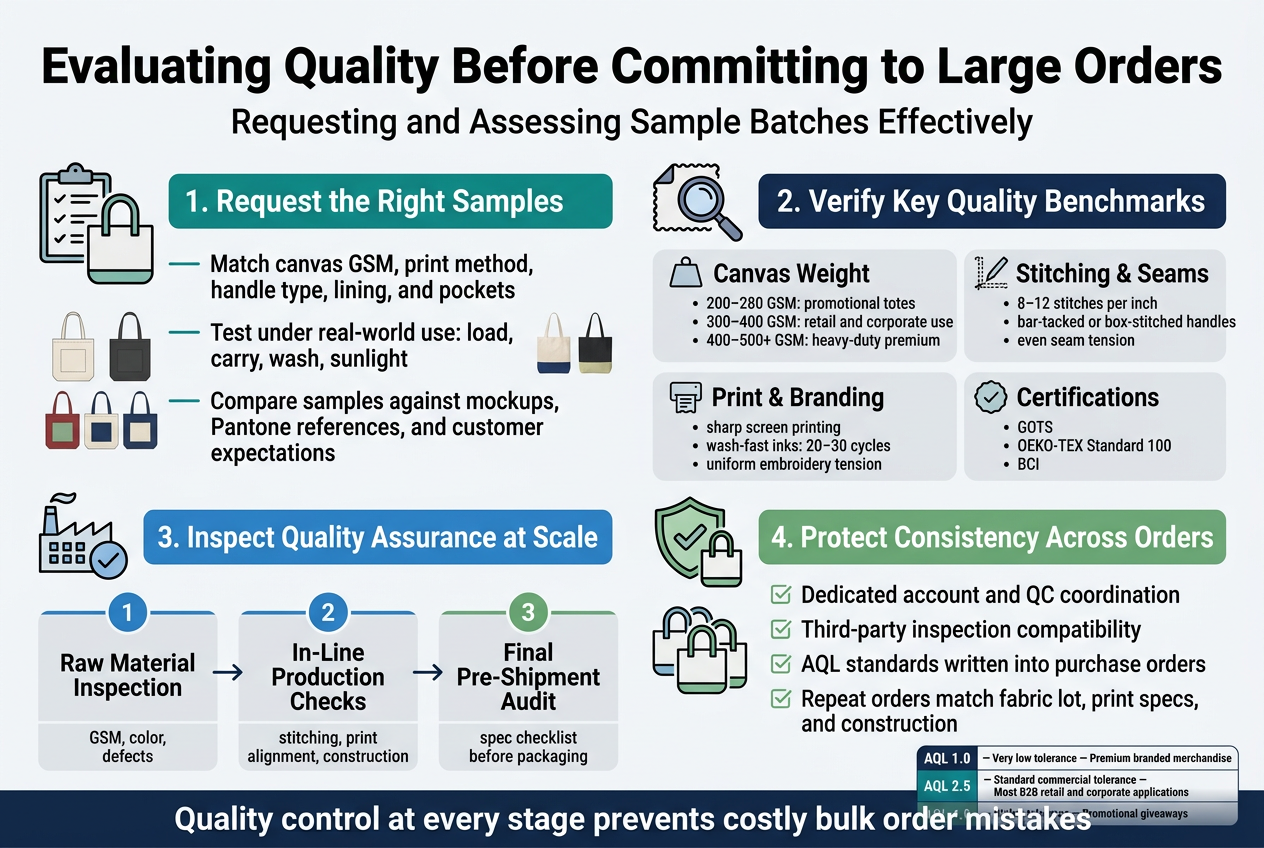
When requesting samples from a white-label bag manufacturer like Paccific Ammara, be specific about what you’re testing. Don’t just order a generic sample and call it done. Request samples that match your actual production specs — the canvas weight you’ve chosen, your print method, your handle type, and any internal lining or pocket configurations you plan to include.
Here’s how to make your sample evaluation process count:
-
- Order samples that reflect your final specifications. A sample made with a different canvas GSM or a different printing process won’t give you accurate data on what your bulk order will look like.
-
- Test the bags under real-world conditions. Load them with products, carry them around, wash them, and expose them to sunlight if outdoor use is part of your use case.
-
- Photograph every detail. Compare the sample against your design mockup side-by-side. Check print alignment, stitching placement, and color accuracy against your Pantone references.
-
- Get samples from multiple colorways if you’re launching a range. Color consistency can vary across dye batches, so checking this early prevents headaches at scale.
-
- Evaluate the sample against your customer’s expectations, not just your own. If your end customers are premium retail shoppers, a sample that seems “acceptable” to you might not clear the bar for them.
Most reputable B2B custom bag manufacturers will offer pre-production samples and production-run samples at different stages. Take advantage of both. The pre-production sample confirms design accuracy; the production-run sample confirms that the factory can replicate quality consistently once the actual run begins.
Key Quality Benchmarks to Verify in Cotton Canvas Bags
When sourcing branded cotton bags wholesale at volume, vague terms like “good quality” don’t cut it. You need measurable benchmarks that your team and your manufacturer can align on from the start. Below are the most important ones to verify before signing off on any large order.
Canvas Weight and Density
Canvas weight is measured in GSM (grams per square meter), and it directly affects durability, structure, and how well the bag holds its shape when loaded.
| GSM Range | Best For |
|---|---|
| 200–280 GSM | Lightweight promotional totes, event giveaways |
| 300–400 GSM | Everyday retail use, grocery bags, branded merchandise |
| 400–500+ GSM | Heavy-duty carrying, premium brand positioning |
For most B2B applications in retail or corporate gifting, a range of 300–400 GSM is the sweet spot. Anything lighter risks looking cheap, and anything heavier increases per-unit cost significantly.
Stitching and Seam Strength
Handle reinforcement is one of the most common failure points in canvas bags. Check:
-
- Stitch count per inch — Higher stitch count means stronger seams. 8–12 stitches per inch is a reasonable standard.
-
- Reinforced handle attachment points — Handles should be bar-tacked or box-stitched at the base to handle real load-bearing use.
-
- Even seam tension — Uneven tension causes puckering and weakens the overall structure over time.
Print and Branding Quality
For eco-friendly custom canvas bags in bulk, print quality is often where brand perception is won or lost.
-
- Screen printing should have sharp edges with no bleeding into the fabric weave.
-
- Water-based or eco inks should be verified for wash-fastness — typically 20–30 wash cycles without significant fading is the standard benchmark.
-
- Embroidery thread tension should be uniform, with no loose ends or puckering on the reverse side.
-
- Digital or DTG printing should be assessed for color vibrancy and coverage, especially on natural, undyed canvas.
Fabric Certifications and Eco Standards
If your brand markets these as eco-friendly canvas bags in bulk, you’ll want documentation to back that up.
-
- GOTS (Global Organic Textile Standard) certification for organic cotton
-
- OEKO-TEX Standard 100 to verify the fabric is free from harmful substances
-
- BCI (Better Cotton Initiative) membership for brands focused on sustainable cotton sourcing
Ask your manufacturer to supply certification documents — not just claim it on a website. These are increasingly important to retail partners and corporate clients who have their own sustainability reporting requirements.
Handle Length and Load Capacity
Standard tote handles run around 70–75 cm in length, which fits comfortably over a shoulder. Verify:
-
- Handle length against your intended use case (a grocery tote has different ergonomic needs than a conference swag bag)
-
- Handle material consistency — cotton rope handles and flat woven handles have different stretch behaviors under load
-
- Attachment method compatibility with the canvas weight being used
How Paccific Ammara Handles Quality Assurance at Scale
Scaling bulk canvas bag sourcing without quality consistency is one of the fastest ways to damage a brand. Paccific Ammara’s approach to quality assurance is built specifically for B2B clients who need repeatable results across multiple production runs — not just for a one-time order.
Multi-Stage Inspection Process
Quality control at Paccific Ammara happens at three distinct points in the production cycle, not just at the end:
-
- Raw material inspection — Fabric rolls are checked for GSM compliance, color consistency, and defect rates before cutting begins.
-
- In-line production checks — Supervisors monitor stitching quality, print alignment, and construction details during the run, not after.
-
- Final pre-shipment audit — Finished bags are inspected against an agreed quality specification checklist before packaging and dispatch.
This approach catches problems before they become full-batch problems — which is especially important when you’re dealing with wholesale cotton tote bags at B2B volumes.
Dedicated Account and QC Coordination
For clients scaling private label canvas bags or white-label bag programs, Paccific Ammara assigns dedicated account managers who understand your brand specs. This means:
-
- Your quality benchmarks are documented and stored per client, not reinvented per order
-
- Any spec changes are flagged and approved before production begins rather than discovered post-delivery
-
- Photo and video documentation of production milestones is shared with clients on request
Third-Party Inspection Compatibility
For brands that require independent verification — particularly those supplying into large retail chains or regulated markets — Paccific Ammara supports third-party inspection agencies such as SGS, Bureau Veritas, and similar organizations.
What this means practically:
-
- Clients can arrange pre-shipment inspections without production delays
-
- The factory is transparent about inspection access, which is not always the case with lower-tier manufacturers
-
- Inspection reports can be shared directly with retail buyers or procurement teams who require them as part of their supplier onboarding process
Defect Rate Standards and Remediation
No manufacturer produces zero defects at scale, but the difference between a trustworthy partner and a problematic one is how defects are handled. Paccific Ammara operates to an AQL (Acceptable Quality Limit) standard, which sets clear, internationally recognized thresholds for acceptable defect rates.
| AQL Level | Defect Tolerance | Typical Application |
|---|---|---|
| AQL 1.0 | Very low tolerance | Premium branded merchandise |
| AQL 2.5 | Standard commercial tolerance | Most B2B retail and corporate applications |
| AQL 4.0 | Higher tolerance | Promotional giveaways, budget tiers |
For custom bag manufacturer partnerships at the B2B level, agreeing on AQL levels upfront — and having them written into your purchase order — removes ambiguity from what happens when defects are found. Paccific Ammara’s remediation policy covers re-production or credit arrangements for batches that fall outside agreed AQL thresholds, which gives sourcing teams a clear path forward rather than a negotiation battle after the fact.
Consistency Across Repeat Orders
One of the biggest pain points in scalable bag manufacturing solutions is color and quality drift between repeat orders. Paccific Ammara retains production records, fabric lot references, and print specifications per client — so when you reorder six months later, the new bags match the previous batch rather than being noticeably different in tone or construction.
This level of documentation-driven consistency is what separates a genuine manufacturing partner from a transactional supplier. For brands building long-term product lines or subscription-style gifting programs, that consistency isn’t a nice-to-have — it’s a basic requirement.
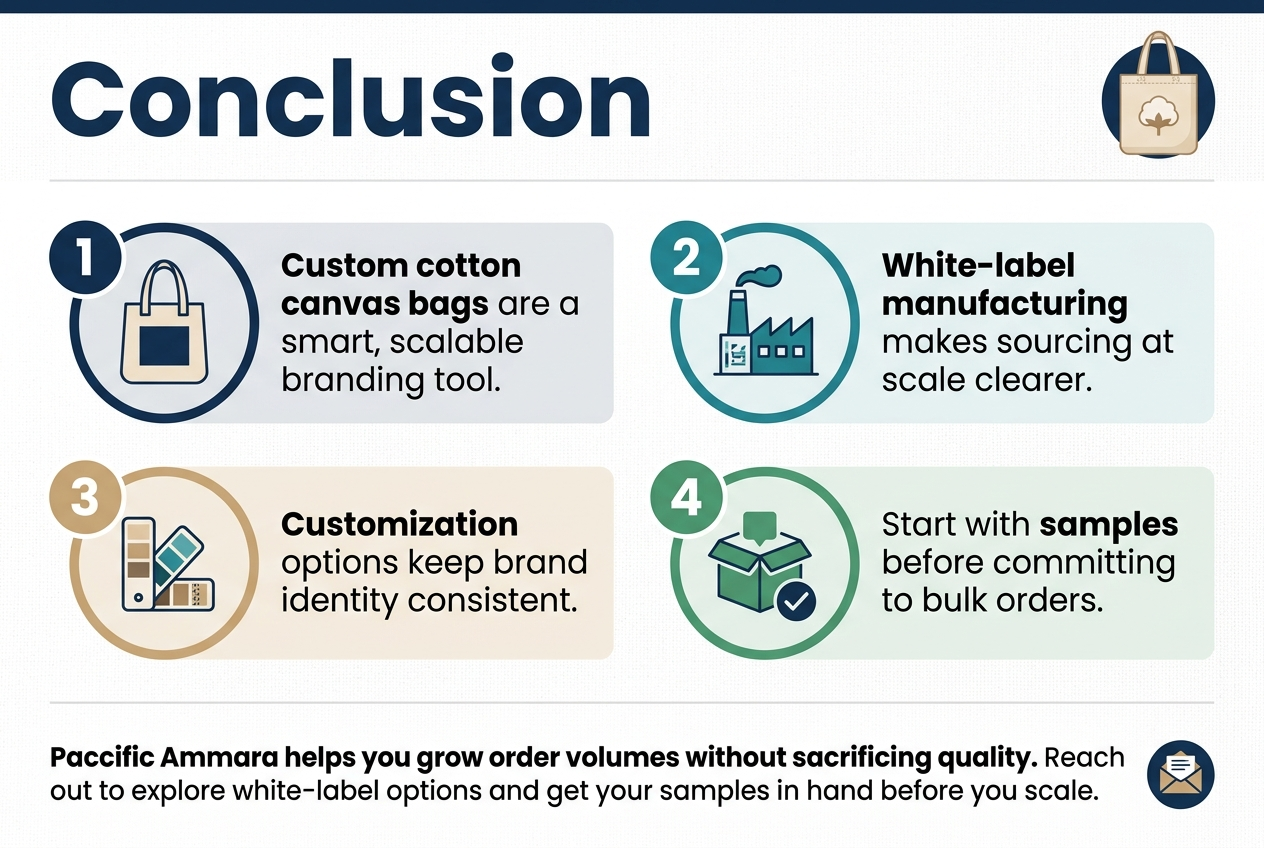
Custom cotton canvas bags have proven to be more than just a product trend — they’re a smart, scalable branding tool that B2B companies are leaning into hard right now. From understanding how white-label manufacturing works to exploring the wide range of customization options available, the path to sourcing these bags at scale is clearer than most brands realize. Paccific Ammara’s approach makes it easier to grow your order volumes without sacrificing quality or brand consistency, and starting with sample evaluations before committing to bulk orders keeps the risk low.
If your brand is ready to level up its promotional or retail packaging game, custom cotton canvas bags are a solid place to start. Reach out to Paccific Ammara to explore white-label options that fit your growth goals — and get your samples in hand before you scale.